Revlr.ai
Revlr crawls up to 25 pages of a site, scores ten categories from performance to compliance, and has Claude write the findings: what is wrong, why it matters, and how much effort the fix takes. Two of those categories exist because answer engines now decide whether a business gets cited at all.
Role
Branding to MVP, a 0-to-1 product build
Type
SaaS product
Status
Early access
Timeline
First commit to public launch in 10 days
292
Commits behind the first release
What I kept hearing
People can see how Google reads their site. Almost nothing tells them how an assistant reads it.
Answer Engine Optimization is how readily a site can be quoted as a direct answer by assistants like ChatGPT and Perplexity. Generative Engine Optimization is how likely AI-generated results are to cite the brand at all. Both now sit between a business and its next customer, and the audit tools people already pay for stop short of them.
See it work
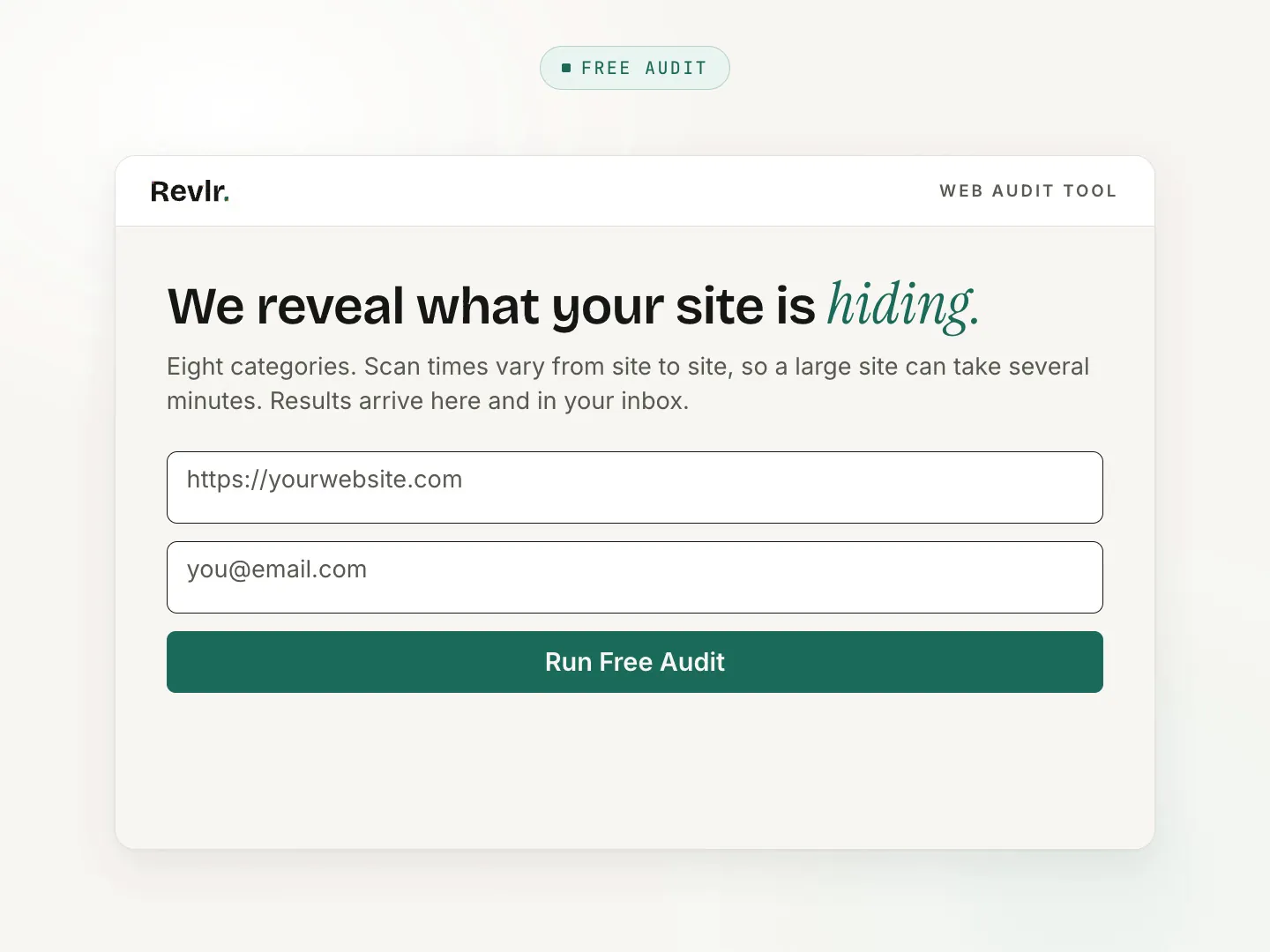
These are Revlr's own screens, recorded from the audit that runs on revlr.ai, sped up so a scan that takes minutes reads in seconds.
Paste a URL and it reads the site the way search engines and AI assistants do. The reel is sped up; a live scan takes longer, and times vary by site.
Why reports go unread
A report that only lists faults is harder to act on than a plan.
Audit output is usually a wall of red: everything wrong, nothing ranked, and no idea what to do on Monday. The scoring also has to be honest enough to re-run, because a number that moves for no visible reason teaches people to ignore it.
What changed
Two new categories for AI search, strengths named before faults, and every finding ranked by severity and effort.
AEO and GEO are scored beside the classic eight, so AI visibility lives in the same report as performance, SEO, accessibility, security and compliance. The report opens with what the site already does well, then orders findings so the low-effort, high-impact fixes come first, each one written in plain language with the fix beside it. Every re-audit shows a delta: what moved, what cleared, what is new. Signing in is an 8-digit code by email, never a password, and a shared report opens for anyone with the link.
Ten days later
First commit to public launch in ten days, then a partner API that now powers the free audit on the agency site.
The first release shipped 39 pages, 27 email templates and 34 database migrations across 292 commits, on Next.js and Supabase with Claude writing the findings. The free audit scores eight categories including AEO and GEO; Premium adds User Experience and Content for the full ten. The same scan runs on andpixels.com through Revlr's partner API.
What we
heard
“Audit tools stop at speed and SEO. Answer engines and generative search now decide whether a business gets cited, and almost nothing checks for it.”
The gap the product was built to close. AEO and GEO are scored beside the eight categories everyone already measures.
Tell me what you’re trying to ship.