Todidit.com
ToDidIt started as the tool I ran my own sprints in. The project tools on the market were built for teams far bigger than mine, so I spent more time working the tool than running the sprint. I rebuilt the same rituals with fewer steps, ran my own work in it for months, and opened it up once it held.
Role
Branding to MVP, a 0-to-1 product build
Type
SaaS product
Status
Public beta
Timeline
4.5 months, internal tool to public beta
10
Product surfaces shipped, from Today to Blueprint
The job to be done
I needed a sprint tool my own size. The ones on the market were built for teams far bigger than mine, so I spent more time working the tool than running the sprint.
ToDidIt was the tool I ran &Pixels sprints in long before it had a pricing page. I rebuilt the rituals I actually used, cut the steps between a thought and a task, and kept running my own work in it until it held. Being the client, the designer and the engineer meant every shortcut cost me directly.
See it work
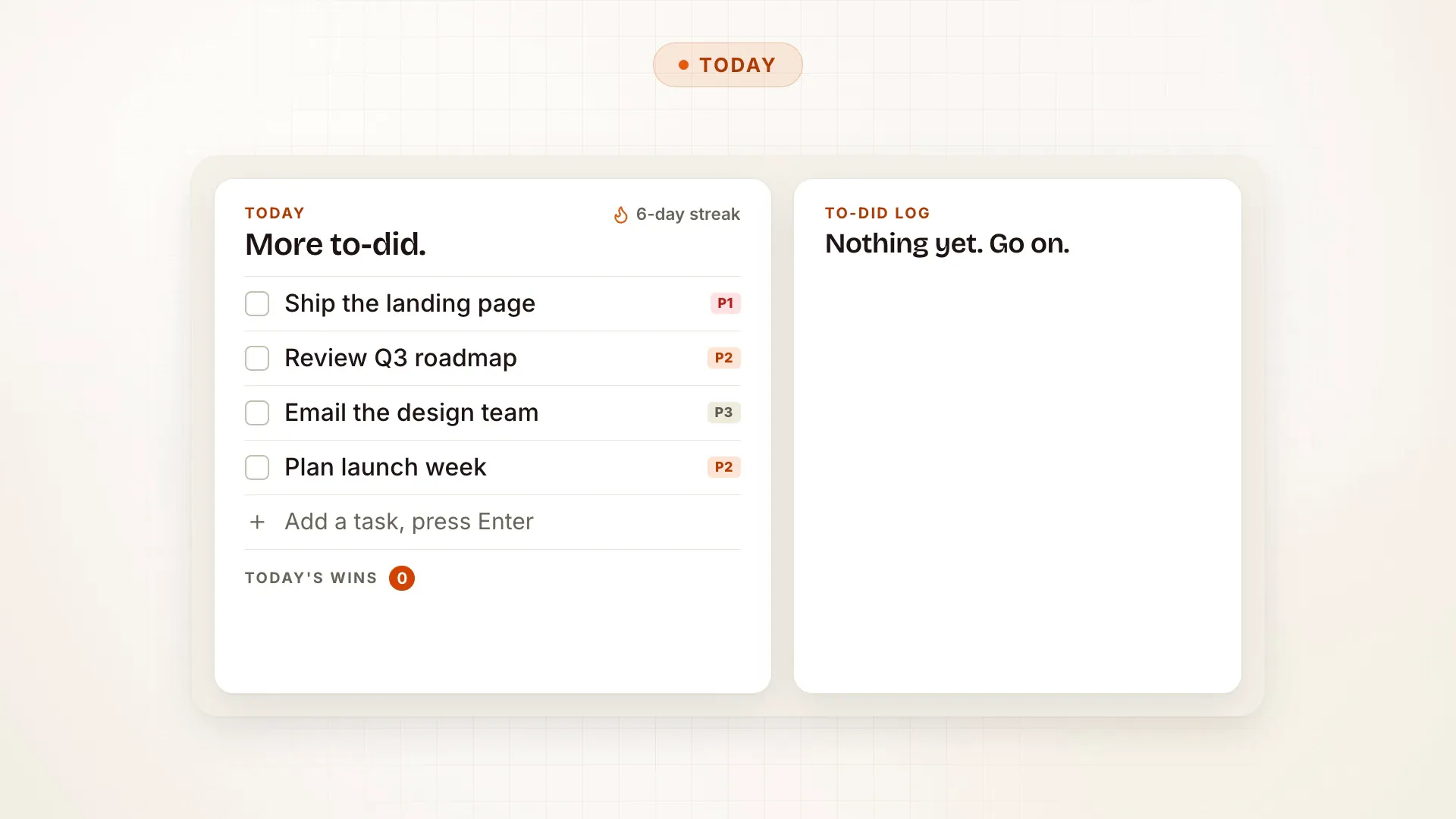
These are ToDidIt's real components, running the same markup, tokens and motion as todidit.com. Check a task off, drag a card, change the view. It is the product, not a picture of it.
Check a task off and watch where finished work goes. It never gets deleted.
Today
More to-did.
Today's wins
0To-Did Log
Nothing yet. Go on.
0 of 4 done
The problem
Finishing is the part that should feel good, and it is the part every task app throws away.
I had my own constraints too: no funding, the most crowded category in software, and an AI that costs money every time someone uses it. I was never going to win on feature count, so the product had to win on how finishing feels and on pricing nobody has to think about.
Live demo
Type a goal. Watch the plan write itself.
Blueprint is ToDidIt's planner. One sentence about what you are shipping, and it writes the whole project: tasks, subtasks, priorities and due dates. This is the product's own demo, and a goal you type here runs the same model the app does.
What are you building?
The design decisions
Keep the wins, charge per account instead of per seat, and meter only the AI.
Finished work goes into a To-Did Log that never deletes, with Win Recap, streaks and Celebration Mode around it. Pricing is flat per account with unlimited teammates, so nobody thinks twice about inviting someone, and Didi's drafts are charged only when you keep one, so throwing one away costs nothing. The first-run quest holds back projects, priorities and due dates until after your first three wins, because that is where the friction sits. Both calls cost me something: revenue that would have grown on its own with every new seat, and row count on a comparison chart.
The outcome
Internal sprint tool to public beta in four and a half months, across ten product surfaces.
The beta shipped the To-Did Log, Win Recap, Celebration Mode and streaks alongside Today, Horizon sprint planning, Projects and Blueprint, with a Slack app and a progressive web app live and iPhone and Android to follow. Horizon, Tasks and Projects all read one task record, so no view needs syncing. Thirty-six pages are live and indexed, and the marketing site scores 100 on desktop PageSpeed.
What we
heard
“Most task apps only show what is left. Finish something and the row disappears, like the work never happened.”
The observation the whole product is built on. Finished work goes into a To-Did Log that never deletes.
Tell me what you’re trying to ship.